REVIEW · KUSADASI
Private Full Day Ephesus Tour from Bodrum
Book on Viator →Operated by OTTI Travel · Bookable on Viator
Ephesus in one full day is a lot to process. This private tour pairs the calm Meryemana (Virgin Mary’s House) with the big Roman-Ephesus sights, all handled with smooth pickup and a driver in a modern A/C Mercedes Vito. You also get skip-the-line entry support so you spend your time walking, not queuing.
I especially like the way the day mixes faith and empire without feeling one-note. The Virgin Mary’s House sits up on the Bulbul mountain in a quieter, greener setting, then you drop into the street-level reality of Ephesus with its major monuments and archaeological streets.
My second big plus is the overall comfort and guidance—guides named in standout past experiences include Melahat, Salim, Tas, Eylem, Selim, Nur, Ulas, and Bano. One thing to consider: the day includes extra ticket costs and you may also have shopping stops (rug/leather-type locations), so you’ll want to decide in advance how you feel about that.
In This Review
- Key things I’d plan around before you go
- How the Bodrum-to-Ephesus day really works (pickup, drive time, and pacing)
- Step one: Meryemana (Virgin Mary’s House) and why the setting matters
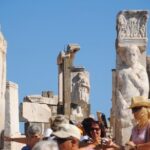
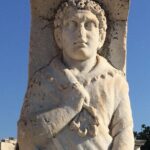
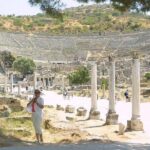
- Ancient City of Ephesus: seeing the scale without losing your day
- State Agora: the politics zone you might otherwise miss
- Odeion: the small theatre that served government and performances
- Hadrian Temple, Domitian Temple, and Hercules Gate: emperor power on Curetes Street
- Temple of Hadrian
- Temple of Domitian
- Hercules Gate
- Terrace Houses: what wealthy Roman family life looked like
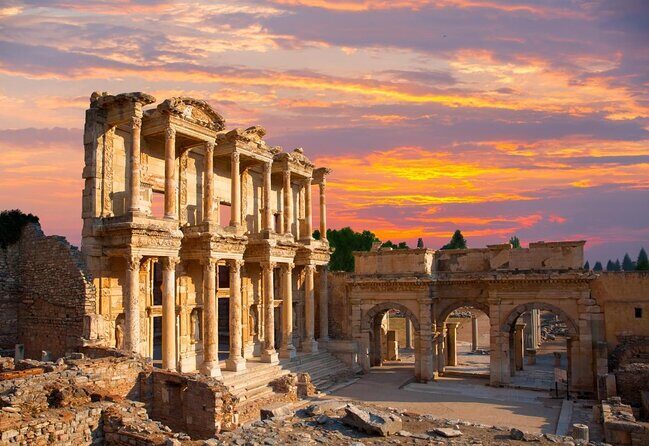
- Celsus Library and the Great Theatre: the two must-see anchors
- Library of Celsus
- Great Theatre
- St. John’s Basilica and the Temple of Artemis ruins: faith plus famous absence
- Basilica of St. John
- Temple of Artemis
- Price and value: what $259 covers, and what costs extra
- Who should book this private Ephesus tour from Bodrum
- Should you book it?
- FAQ
- How long is the private tour from Bodrum?
- Is pickup included?
- Where do cruise passengers meet?
- Is the tour private?
- What language is the guide?
- Are entrance tickets included?
- Is lunch included?
- What is the driving time from Bodrum to Ephesus?
- What vehicle is used?
- Is the tour suitable for everyone physically?
- Can I cancel for a refund?
Key things I’d plan around before you go
- Private transport in an A/C Mercedes Vito with hotel or cruise port pickup
- A structured route that hits Meryemana, State Agora, Odeion, major temples, Terrace Houses, Celsus, the Great Theatre, St. John, and Artemis ruins
- Skip-the-line support plus parking fees handled for you
- Main admissions aren’t included (Ephesus and Meryemana have separate entry fees)
- Shopping stops can happen, so set your boundaries early
How the Bodrum-to-Ephesus day really works (pickup, drive time, and pacing)
This is a private full-day tour out of the Bodrum area to Kusadasi/Ephesus, usually lasting about 6 to 8 hours. The key practical point is that it’s not just “time at the ruins.” You’re committing to a full day built around the drive.
You’ll be picked up either from your Bodrum hotel reception or—if you’re on a cruise—at the exit gate of the immigration terminal at Bodrum Cruise Port, with an OTTI Travel sign. The same idea applies if you’re coming via Bodrum airport: meet at the exit gate of the domestic terminal. The tour includes both pickup and drop-off, plus parking fees and taxes.
Drive time is listed at about 2 hours from Bodrum to Ephesus by drive. In reality, that can stretch depending on traffic and conditions, so I recommend building in a little buffer in your expectations. The schedule also matters: Ephesus is huge, so the route is designed to cover major zones efficiently rather than wandering for hours in one single area.
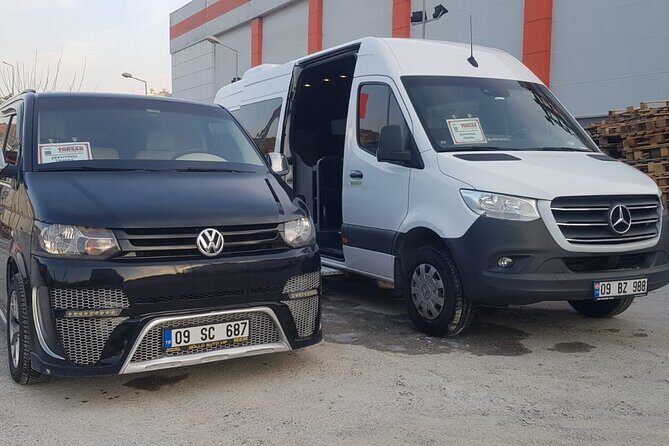
The vehicle is a brand new A/C Mercedes Vito with a private driver. That sounds like a small detail, but it matters in Turkey’s summer heat—especially when you’ve got a long day, multiple walks, and you’re switching between shaded ruins and open sun.
You can also read our reviews of more private tours in Kusadasi
Step one: Meryemana (Virgin Mary’s House) and why the setting matters
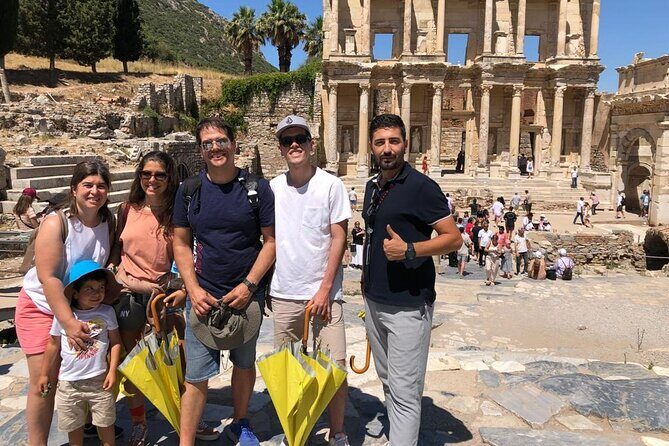
The tour starts at Meryemana, also called the Virgin Mary’s House. It’s located about 9 km ahead of Ephesus, up on the “Bulbul” mountain. The standout detail here is the feeling: the shrine is described as hidden in green, which is a big shift from the exposed, stone-heavy city ruins you’ll see later.
You’ll typically spend about 45 minutes here. The site itself is an important part of why people make the trip:
- The house is described as a typical Roman architectural example, built entirely of stone.
- It’s said to connect with traditions that Mary spent her last days in the area, alongside Saint John.
- In the 4th century AD, a church was built combining her house and grave.
- Inside the story are specific spaces—an anteroom (today with candles proposed), a bedroom and praying room (Christian church area), and a room with a fireplace (chapel for Muslims).
Admission for Meryemana is not included (priced at €18 per person). That means you’ll pay on the day unless the operator tells you otherwise.
What you should do with this stop: treat it like a reset. After the drive, it’s your first slow-down moment. If you’re visiting for spirituality, this is usually the emotional anchor. If you’re visiting for history, it’s a neat contrast: a small Roman-era house story rather than a monumental city statement.
Ancient City of Ephesus: seeing the scale without losing your day
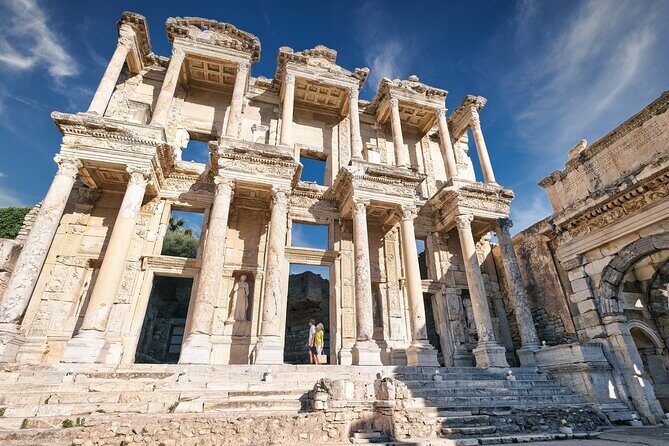
The main engine of the day is the Ancient City of Ephesus. You’ll have about 1 hour 30 minutes for the core site. This is not enough time to “read everything,” but it is enough time to connect the major landmarks into one mental map.
Ephesus is framed in the tour as a succession of civilizations, and the big anchor is the Artemesium (Temple of Artemis), originally built around 356 BC and linked with the Seven Wonders of the ancient world. Later, during the Roman period, Ephesus is described as one of the empire’s great cities—famous for the Temple of Artemis, the Library of Celsus, and even a medical school.
Admission to the Ephesus Ancient City is not included and is priced at €40 per person.
Skip-the-line support is included, which matters here. Ephesus can be hectic. Even a “fast” entry can become a time-waster if you’re paying entry yourself while everyone else does the same thing.
My advice: wear comfortable shoes and move with purpose. This tour is built like a guided highlights walk—if you try to stop for every small artifact, you’ll run out of time and feel rushed. Use the guide for orientation, then let yourself enjoy the big moments: Celsus, the theatre, and the main temple street.
State Agora: the politics zone you might otherwise miss
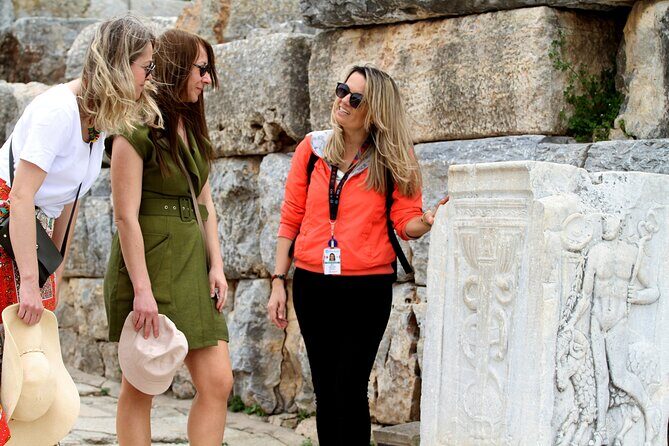
After Ephesus proper, you’ll stop at the State Agora for about 15 minutes. This is a smaller, more “understood” stop than the famous postcard monuments.
What makes it interesting is its function. The agora here isn’t described as a shopping area—it’s described as a business and government meeting space used for discussions. Excavations in the northeast corner are said to show:
- graves from the 7th–6th centuries BC
- a stone-paved road
- an archaic terra cotta sarcophagus
There’s also a water reservoir at the corner of the agora, and the tour notes that water was brought to the city via the Pollio Aqueduct (with remains visible about 5 km away along the Selçuk-Aydin highway).
Admission is not included for this stop. Time is short, so this is more about getting the “why this matters” than about deep artifact study.
Odeion: the small theatre that served government and performances
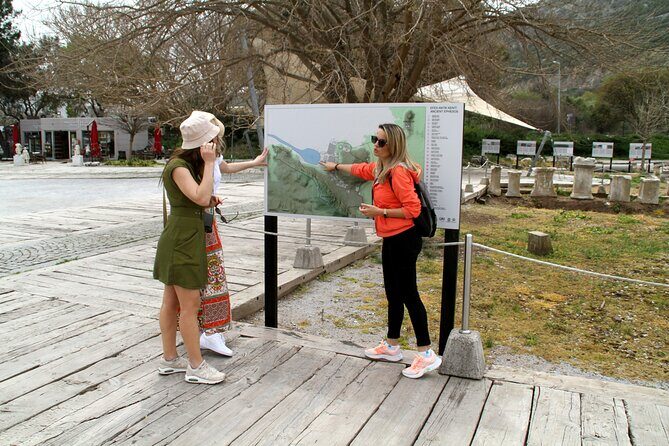
Next is the Odeion, again about 15 minutes. It’s described as a building shaped like a small theatre, with a stage building, seating, and an orchestra. The clever part is the double function:
- it served as a Bouleuterion (meetings of the Boules/senate)
- and as an odeum (a concert hall)
It’s described as built in the 2nd century AD and tied to wealthy citizens, including Publius Vedius Antonius and his wife Flavia Paiana. Capacity is given as 1,500 spectators, and there are restoration notes too: the podium in front of the stage building and parts of seating are restored, and the building used to be enclosed with a wooden roof.
If you like how Roman cities weren’t just for leisure, this stop clicks. It’s a reminder that civic life and entertainment often shared architecture.
You can also read our reviews of more tours and experiences in Kusadasi

Hadrian Temple, Domitian Temple, and Hercules Gate: emperor power on Curetes Street
Curetes Street is where the day gets “classic temple street” energy. You’ll stop at several related structures, mostly 15 minutes each.
Temple of Hadrian
The Temple of Hadrian is described as among the best-preserved structures on Curetes Street. It’s said to have been built before 138 AD and dedicated to Hadrian, who visited from Athens in 128 AD.
You’ll hear about the façade: four Corinthian columns supporting a curved arch, with a central relief of Tyche (goddess of victory). Side columns are square, and the pedestal with inscriptions is described as bases for later emperor statues.
Admission isn’t included for this stop.
Temple of Domitian
The Temple of Domitian is described as the first structure in Ephesus dedicated to an emperor. It sits at the south end of Domitian Street on a broad terrace with vaulted foundations. The tour also emphasizes the scale of the terrace base (about 50 x 100 meters) and how the stairs were still visible.
Architectural details given include a pro-style plan, with eight columns on the short side and thirteen on the long side. It also mentions additional columns in front of the cella, and an u-shaped altar reportedly displayed in the Izmir Museum.
Important for your wallet: the tour data says admission ticket is included for the Domitian Temple stop, unlike most other entries.
Hercules Gate
Near the end of Curetes Street is Hercules Gate. It’s named for a relief of Hercules. The gate pieces were moved in the 4th century AD, but the Hercules relief is said to date back to the 2nd century AD. Only parts remain—“two sides of the columns” are described as remaining today.
The relief of flying Nike in Domitian Square is suggested as potentially related to the gate.
Admission isn’t included for this stop.
Terrace Houses: what wealthy Roman family life looked like
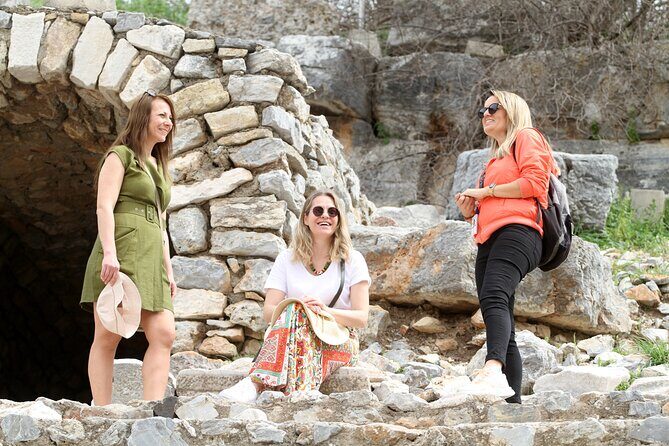
One of my favorite “pause and imagine” stops is the Ephesus Terrace Houses. These sit on the hill opposite the Hadrian Temple and are sometimes called the houses of wealthy Romans.
You’ll have about 30 minutes here, which is a good chunk for a residential-style site.
What’s described in a clear way:
- There are six residential units on three terraces on the Bulbul Mountain slope.
- The oldest building is said to date to the 1st century BC, with use continuing until the 7th century AD.
- The houses have protective roofing resembling Roman houses.
- Mosaics and frescos were consolidated, and two houses were opened to the public as a museum.
Admission isn’t included for this stop.
If you want your day to feel more human—not just monuments—this is where you get daily-life texture. And it’s also a relief valve: the architecture gives you visual shelter compared to open ruin streets.
Celsus Library and the Great Theatre: the two must-see anchors
These are the two big signature sights most people want from Ephesus, and the tour hits both.
Library of Celsus
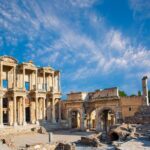
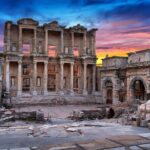
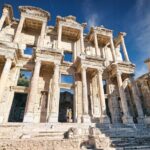
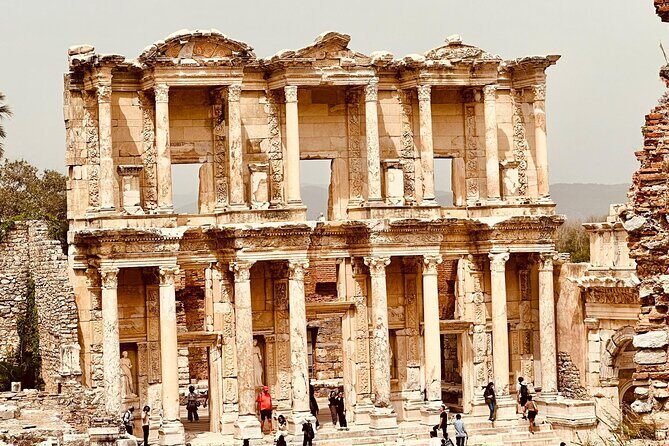
The Library of Celsus is described as one of the most beautiful structures in Ephesus. Built in 117 AD, it’s also described as a monumental tomb for Gaius Julius Celsus Polemaeanus (with his son Galius Julius Aquila named in the narrative).
Key details that help you “read” the building:
- Celsus’s grave is beneath the ground floor and across the entrance.
- There was a statue of Athena over it, tied to wisdom.
- Scroll storage is described as niches in the walls, with a design including double walls behind bookcases to protect from temperature and humidity.
- Capacity is given as more than 12,000 scrolls.
You’ll have about 15 minutes here. Admission isn’t included for this stop.
Great Theatre
The Ephesus Great Theatre is the showstopper for scale. It’s said to be the largest in Anatolia with 25,000 seats. The tour notes it was first constructed in the Hellenistic Period in the 3rd century BC, then expanded in the Roman period into the current style.
You’re given specific “how it fits together” details:
- the theatre sits on Panayir Hill
- it includes 66 rows of seating
- seating is divided into three sections by two diazoma (walkways)
- the theatre is described as used for concerts, plays, religious/political/philosophical discussions, and even gladiator and animal fights
Time is about 15 minutes. Admission isn’t included for this stop.
My practical tip: on hot days, the theatre can feel like it’s made of sun. Bring water, use shade when you can, and don’t expect “quiet contemplation” here. It’s an active, open-air space.
St. John’s Basilica and the Temple of Artemis ruins: faith plus famous absence
The last stretch leans more spiritual and mythic.
Basilica of St. John
At St. John’s Basilica, you’ll spend about 30 minutes. The tour connects it to tradition: St. John spent his last years in the region around Ephesus and was buried on the southern slope of Ayosolug Hill.
The narrative given includes:
- a small chapel constructed over the grave in the 4th century
- the basilica changed/expanded during the time of Emperor Justinian (527–565 AD)
- links to early Christian persecution and texts (Gospel in Ephesus and Revelation on Patmos in 96 AD)
Admission isn’t included for this stop.
This is a good moment to slow down after walking. Even if you’re not religious, you’ll likely find the setting more reflective than the main street temples.
Temple of Artemis
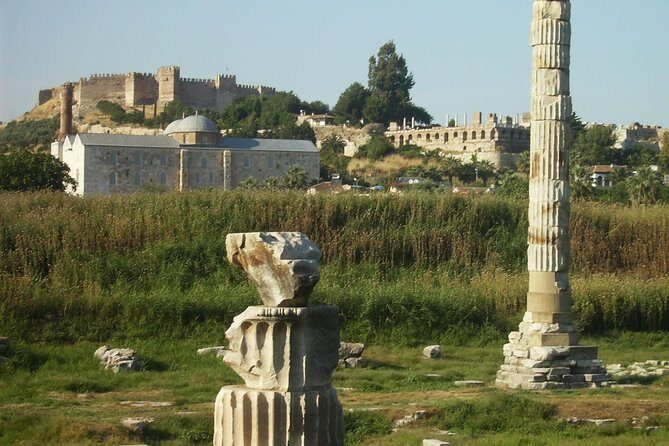
Then there’s Temple of Artemis, a classic case of “you can’t see the whole thing.” The tour notes that over centuries, the site became a swamp, so today you mainly see ruins of the foundations.
What remains visible are described as foundations, and the tour points out that many beautiful pieces are in the British Museum.
Time is about 25 minutes here. Admission is listed as free for this stop.
Price and value: what $259 covers, and what costs extra
At $259 per person, the price looks simple. The value is in what you’re not juggling:
- Private A/C Mercedes Vito transport with a driver
- Hotel and cruise port pickup/drop-off
- English speaking professional licensed tour guide
- Guaranteed skip-the-line
- Parking fees and all taxes
The “extras” you should budget for are clear:
- Ephesus Ancient City entry: €40 per person (not included)
- Virgin Mary House entry: €18 per person (not included)
- Lunch: $15 per person (listed as not included)
There’s also a note that Temple of Domitian admission is included. That’s small, but it reduces one of the ticket payments.
So the real question is: is this worth it versus DIY? For many people, yes—because your day is built around time efficiency and coordination. Paying admissions separately still happens, but skip-the-line support plus one English guide and a private driver is the practical advantage.
One more thing: shopping stops. Some guided days can include a rug stop (and sometimes leather-type showcases). If you don’t want that, decide early whether you’ll browse politely or ask to adjust. The tour data itself doesn’t list those stores as formal “included stops,” but it does line up with shopping-type experiences described in past experiences. Plan your comfort level before you commit.
Who should book this private Ephesus tour from Bodrum
This tour fits you well if:
- you want a private day plan instead of dealing with buses and schedules
- you care about both religious heritage (Meryemana, St. John) and major Roman sites
- you prefer an English guide to connect the dots across different eras
- you value skip-the-line support and pickup convenience
It may not be your best match if:
- you’re hoping for a “no extras, no shopping” day
- you dislike paying multiple sites’ entry fees in the moment
- you want lots of free time for wandering far beyond the main monuments
Should you book it?
If your priority is seeing the Ephesus highlights plus Meryemana in one well-managed day, I think this is a solid choice. The comfort (A/C Mercedes Vito), guide quality (names like Melahat, Salim, Eylem, Nur, Ulas, Selim, Tas, and Bano show up in praised experiences), and skip-the-line approach are the big reasons.
Just go in with eyes open: budget for €40 + €18 on top of the base price, and be ready for a possible shopping-style detour. If that works for you, this is the kind of day that leaves you with images you’ll remember and a clearer sense of how the ancient city worked.
FAQ
How long is the private tour from Bodrum?
It runs about 6 to 8 hours.
Is pickup included?
Yes. Pickup and drop-off are included from Bodrum hotels and the Bodrum cruise port, and there are also pickup details for Bodrum airport.
Where do cruise passengers meet?
Cruise passengers meet at the exit gate of the immigration terminal at the Bodrum Cruise Port, with a board showing the OTTI Travel sign.
Is the tour private?
Yes. It’s described as private, with only your group participating.
What language is the guide?
The tour is offered in English.
Are entrance tickets included?
Not all of them. The Ephesus Ancient City admission (€40) and Virgin Mary House admission (€18) are not included. Temple of Domitian admission is listed as included. Temple of Artemis is listed as free.
Is lunch included?
Lunch is not included, but a local lunch is listed at $15 per person.
What is the driving time from Bodrum to Ephesus?
It takes about 2 hours from Bodrum to Ephesus by drive, and timing can be affected by traffic and conditions.
What vehicle is used?
A brand new A/C Luxury Mercedes Vito with a private driver.
Is the tour suitable for everyone physically?
It says travelers should have a moderate physical fitness level.
Can I cancel for a refund?
Yes—free cancellation is available. You must cancel at least 24 hours in advance for a full refund.